
Soft, juicy, spongy and delicately sweet, Rasgulla is one of those Indian desserts that can instantly make a celebration feel complete. Whether served after a family dinner, shared during Diwali, offered to guests or simply enjoyed when you are craving something sweet, Rasgulla has remained a favourite across generations.
Today, the love for traditional Indian sweets has travelled far beyond India. In Australia, growing South Asian communities and increasing interest in international cuisines mean that sweets such as Rasgulla are becoming easier to discover and enjoy. From Sydney and Melbourne to Brisbane, Perth and Adelaide, people looking for authentic Indian sweets in Australia are becoming increasingly familiar with this syrupy delicacy.
But Rasgulla is far more interesting than its simple appearance suggests. Behind every soft white ball lies a story of culinary skill, regional traditions and centuries of evolving food culture.
Here are 10 delicious facts about Rasgulla you should know.
1. Rasgulla Is Made from Fresh Chhena
One of the most interesting things about Rasgulla is how few basic ingredients are needed to create it.
Traditional Rasgulla is primarily made using chhena, a fresh milk curd produced by coagulating milk. The chhena is drained, kneaded until smooth, shaped into small balls and then cooked in sugar syrup.
Although chhena is sometimes casually described as cottage cheese or paneer, the texture required for Rasgulla is more delicate than the firm paneer commonly used in savoury Indian dishes. Properly prepared chhena needs enough moisture and softness to produce Rasgullas that expand during cooking without breaking apart.
The characteristic sweet is therefore less about complicated ingredients and more about technique. Food research describes Rasgulla as a soft, syrupy cheese-based sweet made by processing chhena and cooking it in sugar syrup until the desired soft and spongy consistency develops.
That simplicity is part of Rasgulla’s charm. Milk, sugar and skilled preparation come together to create something completely different from the ingredients with which the process began.
2. The Famous Spongy Texture Requires Real Skill
Anyone who has eaten a beautifully made Rasgulla knows that texture is everything.
A good Rasgulla should be soft, light and springy, rather than hard, grainy or rubbery. When gently pressed, it should compress slightly and then regain much of its shape. Take a bite and the sweet syrup stored within its porous structure should immediately release.
Achieving that consistency requires careful preparation.
The chhena needs to be kneaded correctly so that it becomes smooth without becoming overly greasy. The balls should also be shaped without visible cracks. Cooking temperature, syrup concentration and cooking time all affect the final result.
If the chhena contains too much moisture, the balls may fall apart. Too little moisture can produce hard Rasgullas. Over-kneading or incorrect cooking can also change the texture dramatically.
This is why two Rasgullas prepared from similar ingredients can taste remarkably different. Traditional sweet-making is as much a craft as it is a recipe.
3. Rasgulla Has a Fascinating and Debated History
Ask where Rasgulla originated and you may quickly find yourself in one of India’s most famous food debates.
Both West Bengal and Odisha have deep cultural associations with the sweet, although their traditions and historical narratives differ.
In Bengal, the modern spongy form of Rasgulla is strongly associated with Kolkata confectioner Nobin Chandra Das, who is widely credited with developing and popularising the version in the nineteenth century. Food-history research discusses accounts linking his experiments with the development of the soft, spongy Rasgulla around the 1860s.
Odisha, meanwhile, has its own longstanding Rasagola tradition associated particularly with Puri and religious customs connected with Lord Jagannath. India’s official tourism information also describes the traditional connection between Rasagola and Puri’s religious culture.
Rather than reducing Rasgulla’s story to one simple claim, it is more accurate to recognise that different regional versions have developed their own distinct histories and cultural significance.
That rich background makes eating Rasgulla an experience connected not only with flavour but also with Indian culinary heritage.
4. Bengal and Odisha Have Their Own GI-Recognised Traditions
The Rasgulla story becomes even more fascinating when you look at India’s Geographical Indication, or GI, registrations.
Banglar Rasogolla, associated with West Bengal, received its GI registration certificate on 14 November 2017 according to Intellectual Property India.
Later, Odisha Rasagola was separately registered, with its GI certificate dated 29 July 2019.
These registrations are important because they recognise distinct regional products rather than simply declaring ownership of every sweet called Rasgulla.
It also highlights something wonderful about Indian cuisine: the same broad category of food can develop different characteristics, preparation traditions and cultural meanings from one region to another.
For food lovers in Australia exploring authentic Indian desserts, this makes Rasgulla an excellent example of how diverse Indian sweet-making traditions can be.
5. Rasgulla Has More Than One Spelling
You may have seen the same sweet described as:
Rasgulla, Rasagola, Rasogolla, Rosogolla or Rasagulla.
Confusing? Perhaps at first.
However, these spellings often reflect different regional languages, pronunciations and transliterations into English.
“Rasgulla” has become one of the most widely recognised English spellings, particularly outside India. “Rosogolla” or “Rasogolla” is commonly associated with Bengali pronunciation, while “Rasagola” is frequently used in Odisha.
Whatever spelling appears on the box, the name instantly brings to mind that familiar family of soft chhena-based sweets soaked in syrup.
This is particularly useful to know when searching online for Rasgulla in Australia, as different Indian sweet shops, supermarkets and food businesses may use different spellings.
6. Sugar Syrup Does More Than Make Rasgulla Sweet
It would be easy to assume that sugar syrup is simply added at the end to sweeten Rasgulla. In reality, it plays a much more important role.
The shaped chhena balls are cooked in the syrup, allowing them to expand while developing their signature soft structure. As they cook, the liquid penetrates the porous sweet.
That is why cutting into a properly prepared Rasgulla reveals a moist interior rather than a dry centre.
The concentration of the syrup also matters. An excessively heavy syrup can overpower the delicate dairy flavour, while a properly balanced syrup keeps the dessert juicy without making its texture unpleasantly sticky.
This combination of sweetness, moisture and lightness distinguishes Rasgulla from many other Indian mithai varieties.
It also makes Rasgulla particularly refreshing when served slightly chilled—something that can be especially enjoyable during warmer Australian weather.
7. Rasgulla Is Very Different from Gulab Jamun
People discovering Indian desserts for the first time sometimes confuse Rasgulla and Gulab Jamun, especially because both are round sweets served in syrup.
Yet they are remarkably different.
Rasgulla is typically pale or white and is made primarily from fresh chhena. Its texture is light, spongy and juicy.
Gulab Jamun, on the other hand, is generally prepared using milk solids or similar dairy-based dough, shaped into balls and fried until golden or brown before being soaked in flavoured sugar syrup. This creates a richer, denser and more indulgent texture.
In simple terms:
Rasgulla = light, spongy and syrup-filled.
Gulab Jamun = rich, fried, soft and dense.
Both have earned iconic status, but their preparation methods and eating experiences are completely different.
If you’re putting together an Indian dessert platter for a celebration in Australia, serving both is a great way to showcase the variety found within traditional Indian sweets.
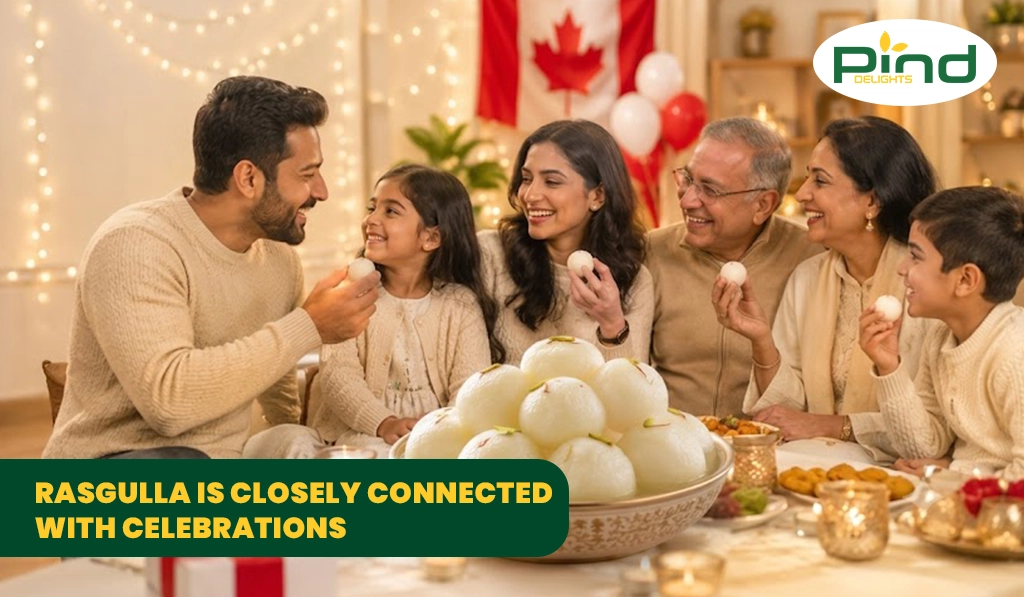
8. Rasgulla Is Closely Connected with Celebrations
In Indian culture, mithai is rarely just dessert.
Sweets are associated with hospitality, festivals, family gatherings, achievements, weddings and gifting. Rasgulla fits naturally into that tradition.
A box of Rasgulla may be opened when relatives visit, passed around during a celebration or served after a festive meal. For many families living overseas, traditional sweets also provide an emotional connection with familiar flavours and memories from India.
That makes Rasgulla particularly meaningful within Australia’s multicultural food landscape.
For Indians living in Australia, enjoying traditional mithai during Diwali, Raksha Bandhan, Holi, weddings, birthdays and family occasions can help recreate a small part of home. At the same time, sharing sweets such as Rasgulla gives friends and colleagues from different cultures an opportunity to experience authentic Indian flavours.
Food, after all, is one of the easiest ways for traditions to travel.
9. Rasgulla Contains Dairy Nutrients—but It Is Still a Sweet
Because Rasgulla is made from milk-derived chhena, it naturally contains some dairy-based nutrients, including protein and minerals.
However, that doesn’t turn Rasgulla into a health food.
Traditional Rasgulla is cooked and stored in sugar syrup, meaning its sugar intake should be considered when deciding portion size. The exact nutritional profile also varies considerably depending on the recipe, size of each Rasgulla and concentration of the syrup.
The best approach is simple: enjoy Rasgulla as what it is—a delicious dessert.
One or two pieces can provide a satisfying sweet finish to a meal without requiring an oversized serving. People monitoring sugar intake for medical or dietary reasons should follow professional advice appropriate to their individual needs.
Traditional desserts don’t need unrealistic health claims to be enjoyed. Quality ingredients, authentic preparation and sensible portions allow Rasgulla to remain part of a balanced approach to food.
10. Rasgulla Has Become a Global Indian Favourite
Perhaps the most exciting fact about Rasgulla is just how far this traditional sweet has travelled.
What was once primarily associated with eastern Indian sweet-making traditions is now enjoyed in Indian households and restaurants around the world.
Australia is no exception.
As the country’s Indian and South Asian communities have grown, demand for authentic regional food has expanded as well. Australians can now explore far more than familiar curries and savoury dishes. Traditional mithai—including Rasgulla, Gulab Jamun, Kaju Katli, Barfi and Ladoo—is becoming part of the wider discovery of Indian cuisine.
Rasgulla is particularly suitable for people trying Indian sweets for the first time because its flavour profile is relatively simple: fresh dairy notes combined with light sweetness and an unusual juicy, spongy texture.
Serve it chilled after an Indian meal, include it on a festive dessert platter, offer it to guests or pair it with other mithai to experience contrasting flavours and textures.
For anyone searching for traditional Indian sweets in Australia, Rasgulla deserves a place near the top of the list.
Why Rasgulla Continues to Win Hearts
Rasgulla proves that extraordinary food does not always require a long list of ingredients.
Its appeal comes from transformation: fresh milk becomes delicate chhena, chhena becomes smooth round balls, and those balls become incredibly soft and juicy after being cooked in sugar syrup.
Add its fascinating history, regional identities, cultural significance and distinctive texture, and it becomes easy to understand why Rasgulla has remained one of India’s most recognised sweets.
For Australians discovering the diversity of Indian cuisine—or Indians in Australia searching for flavours that remind them of celebrations back home—Rasgulla offers much more than sweetness.
It carries with it tradition, craftsmanship, memories and the simple happiness of sharing mithai with the people around you.
So, the next time you are exploring Rasgulla in Australia, don’t just think of it as a syrupy dessert. Take a moment to appreciate the generations of sweet-making tradition hidden inside every soft, spongy bite.
FAQ SECTION ABOUT RASGULLA
Is rasgulla the same as gulab jamun?
No, rasgulla and gulab jamun are different Indian sweets. Rasgulla is made from fresh chhena and cooked in sugar syrup, giving it a soft, spongy and juicy texture. Gulab jamun is usually made from milk solids, fried until golden brown and then soaked in sugar syrup, making it richer and denser.
What does rasgulla taste like?
Rasgulla has a mild, milky and pleasantly sweet flavour. Its soft and spongy texture absorbs the sugar syrup, making every bite juicy and refreshing. It is generally lighter in taste compared with many rich Indian sweets.
Is rasgulla Bengali or Indian?
Rasgulla is a traditional Indian sweet strongly associated with eastern India, particularly West Bengal and Odisha. Both regions have their own distinctive traditions and versions of the sweet. Today, rasgulla is enjoyed throughout India and in countries such as Australia.
Is rasgulla healthy or unhealthy?
Rasgulla is made from milk-based chhena, which provides some protein and dairy nutrients. However, it is also prepared and served in sugar syrup, so it should be enjoyed in moderation. As an occasional dessert and in sensible portions, rasgulla can be part of a balanced diet.